
The Rise of the Intelligence Architect
Why Forward-Deployed Engineers are just the beginning.
There's a thoughtful conversation gaining momentum right now about the Forward-Deployed Engineer — the embedded, multi-skilled operator who sits beside the customer, speaks both business and technology fluently, and turns AI ambition into production reality. The term traces back to Palantir's embedded engineers and has since spread to the AI labs and hyperscalers. It's a conversation worth having. I agree with most of it.
I also think it stops one step short of the role the enterprise actually needs.
For most of my career, I've lived at the seam between business intent and technical execution. I started by introducing online banking to customers who didn't trust the internet, and I've spent the years since helping organizations turn skepticism into adoption — across financial services, healthcare, retail, and beyond. More recently, I've designed, deployed, and scaled AI agent systems in production. So when I read about the Forward-Deployed Engineer, I don't see the destination. I see the on-ramp.
Here's my point of view, plainly stated:
The Forward-Deployed Engineer proves that AI can work beside the customer. But the role that decides whether it scales — whether it becomes an enterprise capability rather than a brilliant one-off — is bigger. I see it as the Intelligence Architect.
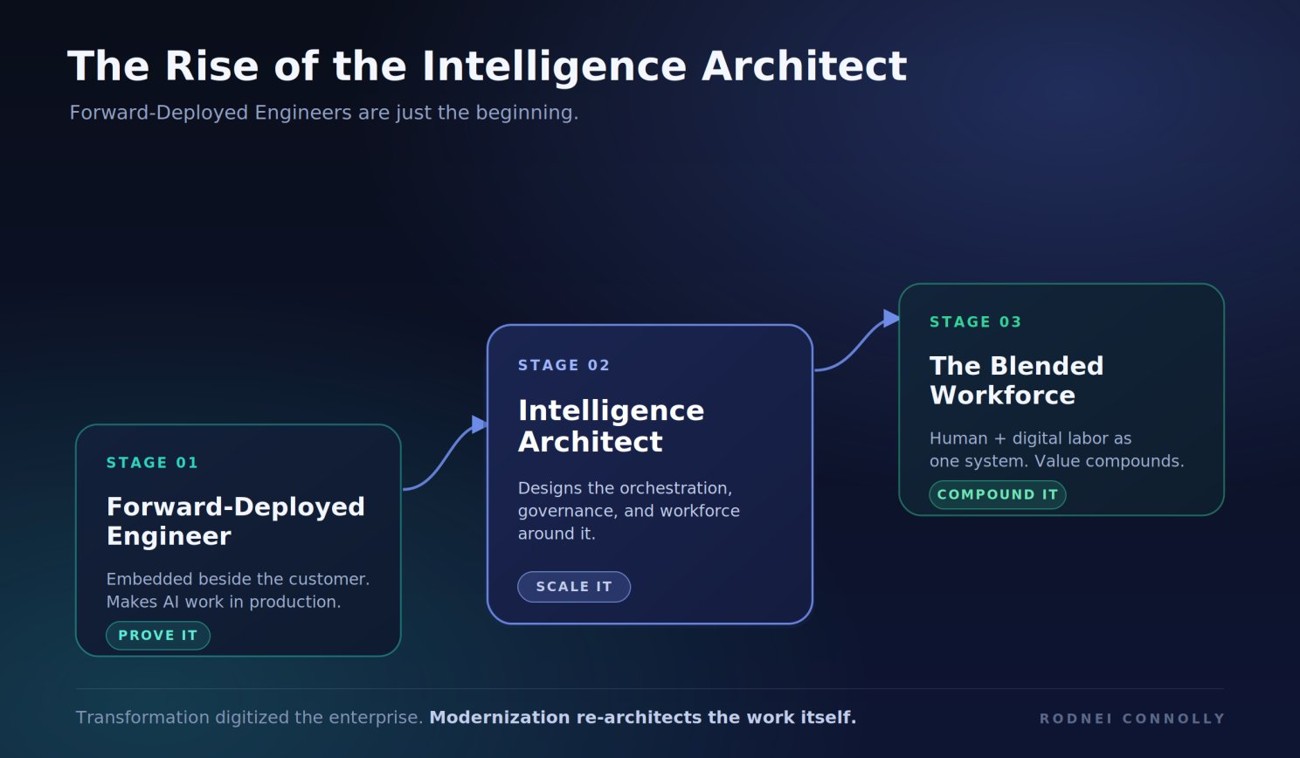
The Intelligence Architect is the leader who designs how human and digital labor operate as one system — defining the roles, the orchestration, the governance, and the value model of an entirely new category of workforce. Where the Forward-Deployed Engineer is embedded to make AI work, the Intelligence Architect builds the operating model that lets it scale, stay trusted, and deepen the relationships that create enduring value.
Treat AI as a hiring problem and you'll repeat the most expensive mistake of every prior technology wave. Treat it as an architecture problem — a workforce to be designed — and you unlock something far larger. Let me walk through why.
What the FDE Conversation Gets Right
Credit where it's due. The core insight is sound.
Deploying AI at enterprise scale was never a purely technical exercise. It collapses the moment it hits the translation gaps between cloud, data, application, domain, and the customer. The embedded operator closes those gaps. They compress proof-of-concept timelines. They sit with the people who own the problem instead of receiving requirements third-hand. They turn "the model works in the lab" into "the business runs on it."
I've watched this dynamic decide whether AI programs live or die. The teams that win don't have better models — they have someone who can hold the technical and the human in the same hand. That's the FDE thesis, and it's correct. It is also where most of the conversation stops. The Intelligence Architect is what comes next.
The Trap Hiding Inside the Cost Story
The most seductive version of the FDE argument is the one about cost: one multi-skilled operator replaces four or five specialists, so you save money and remove handoffs.
In my previous article, "Your AI Business Case Is Missing 70% of the Costs," I unpacked why this kind of math is a trap. In an enterprise agentic system, cost doesn't live where the spreadsheet looks. It lives in human-in-the-loop review, in Day-2 operations, in model migrations, in compliance and risk — the dimensions that never appear in a vendor pitch deck. (All figures here are directional, drawn from generalized enterprise scenarios — calibrate to your own context.)
Consolidating five roles into one brilliant operator doesn't make those costs disappear. It relocates the blind spot. A hyper-skilled engineer with no system around them doesn't eliminate the orchestration problem — they just build toward it faster. You end up with expensive shelfware delivered in record time. The proof-of-concept dazzles. The production reality drains the budget. And leadership is left wondering why the results never matched the investment.
I've said this before in my work on agent orchestration, and it holds here: individual agents succeed; ecosystems fail. The same is true of individual people.
A Forward-Deployed Engineer without a system around them is a talented musician playing alone. The Intelligence Architect is the one who writes the score.
From Forward-Deployed Engineer to Workforce Intelligence Architect
Three shifts in thinking move you from the embedded operator to the architect of the system. They've held up for me in production, across every industry I've worked in.
- It's a capability, not a job title. The instinct is to post a requisition for a unicorn who masters cloud, data science, application development, domain expertise, and CXO communication all at once. Those people are rare, expensive, and — critically — non-repeatable. You cannot scale an enterprise on the assumption that you'll keep finding them. The Intelligence Architect's job is to engineer that capability into the operating model so it no longer depends on any single heroic individual.
- The value is in the connective tissue, not the components. I've argued for a decade — long before agents — that a cohesive digital ecosystem beats a collection of best-in-class parts. Interoperability, governance, lifecycle discipline, and shared infrastructure are what turn capable components into enterprise outcomes. The FDE is the most capable component yet. The Intelligence Architect designs the layer that lets it scale, repeat, and survive contact with regulators, audits, and Day-2 reality.
- The real mandate isn't to build agents. It's to build the bridge. The defining skill here isn't full-stack fluency. It's trust translation — the ability to make a skeptical executive, a cautious compliance officer, and a wary customer all believe in something they can't see inside. I learned this at a bank counter, not in a deployment pipeline. It's the one competency the technical framing consistently undervalues, and it's the one that decides adoption.
The Intelligence Architect and the New Category of Workforce
Here's where I want to take the conversation further than it's currently going.
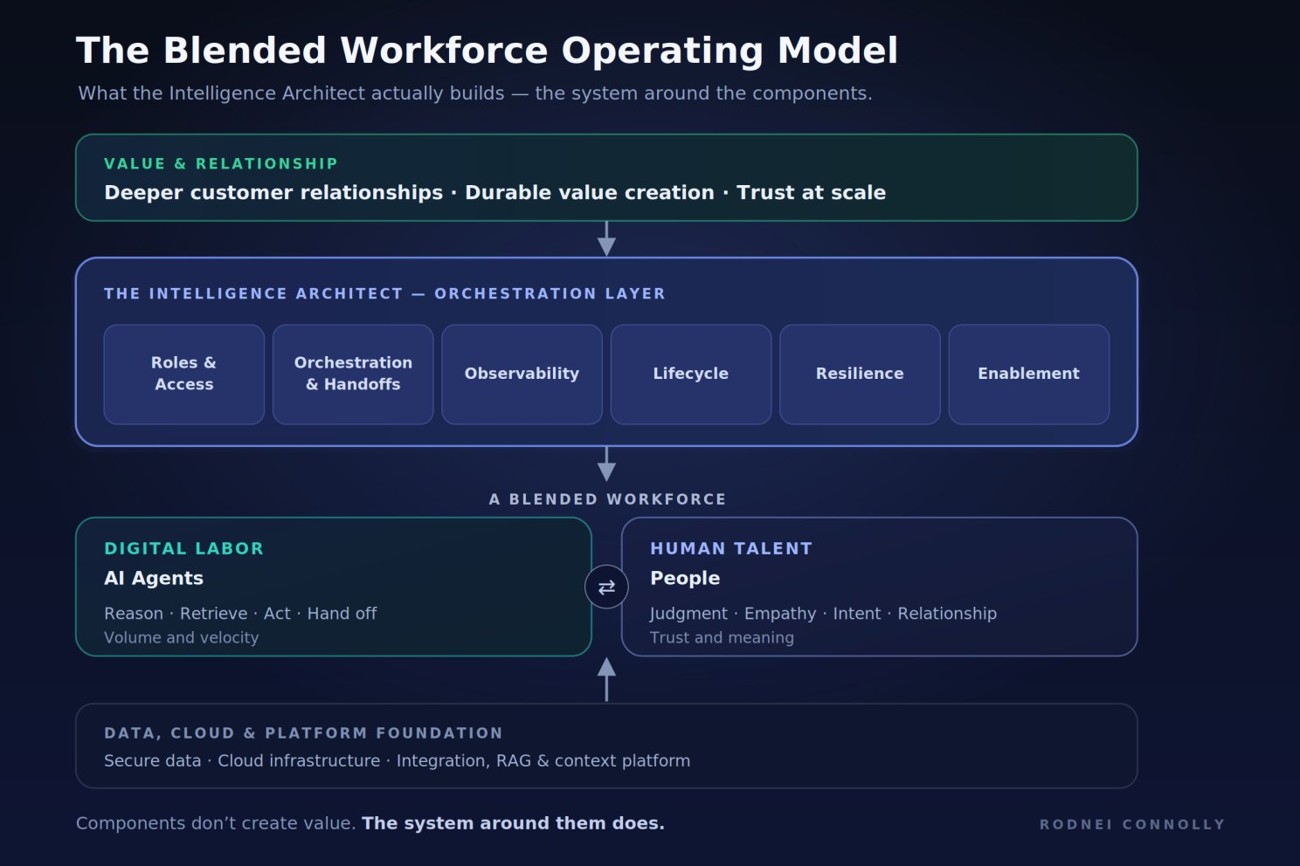
We are not just adding a new role. We are standing up an entirely new category of workforce — one where human talent and digital labor work side by side. Agents that reason, retrieve, act, and hand off. Humans who set intent, exercise judgment, carry empathy, and own the relationship. The enterprise of the next decade won't be staffed only by people, and it won't be automated entirely by machines. It will be blended.
Designing that blended workforce — deciding how human and digital labor divide the work, hand off to one another, and stay accountable to the business and the customer — is the Intelligence Architect's defining work. The Forward-Deployed Engineer makes the first agent useful. The Intelligence Architect makes the workforce coherent.
This is the move from transformation to modernization. Transformation digitized the enterprise. Modernization re-architects how work itself gets done — and who, or what, does it. The organizations that win won't be the ones that hire the most engineers. They'll be the ones whose Intelligence Architects stand up a repeatable, governed, blended workforce that compounds in value over time.
And the prize at the end of that isn't efficiency. It's relationship. When a blended workforce is orchestrated well, agents handle the volume and the velocity while humans invest where judgment, empathy, and trust create durable customer relationships. That's where the real value lives — not in minutes saved, but in relationships deepened and value created at a scale neither humans nor machines could reach alone.
What the Intelligence Architect Builds
If you're a leader wondering what this role actually produces, here's what production has taught me — stated as principles, not promises.
- Foundations before flair. Define roles, boundaries, and access control before you orchestrate anything. Wiring a building before drawing the blueprint is how programs go reactive — and reactive is the most expensive way to operate.
- Observability is non-negotiable. Every organization eventually faces a "what happened?" moment. Without comprehensive logging from day one, answering it is archaeology, not operations.
- Lifecycle discipline saves more than any optimization. Model drift, version conflicts, and migrations are inevitable. Mature teams absorb them; everyone else firefights.
- Resilience is a design decision, not an incident response. If the first time you think about failure is when it happens, you're already in crisis.
- Governance lives inside the strategy, not bolted on after. Trust, compliance, and accountability aren't constraints on the workforce — they're what makes the workforce credible to customers and regulators alike.
- Enablement is the bridge between building and adoption. I've deployed systems that were architecturally sound and operationally irrelevant because no one was equipped to work within them. The human layer is not a nice-to-have.
None of these are optional. And none of them work in isolation. They form a system — which is exactly the point, and exactly the job.
The Leadership Question That Actually Matters
The wrong question is: "How many Forward-Deployed Engineers should we hire?"
The right question is: "Who is architecting our blended human-and-digital workforce — so it scales, stays governed, and deepens our relationships with the people we serve?"
That's a fundamentally different decision. It's not a staffing line item. It's an architecture choice — and it belongs in the C-suite, not the requisition queue.
The Forward-Deployed Engineer is just the beginning. I'm genuinely glad the conversation is having its moment, because it points at something true. But the enterprises that will define this era won't be the ones that adopt fastest — they'll be the ones that adopt smartest: building the orchestration, the governance, and the blended workforce that turn one brilliant operator into a force multiplier across the whole organization. That work has a name. It belongs to the Intelligence Architect.
It's the work I've spent my career becoming — standing at the boundary between the machine and the human and making the two create value together. The tools have changed. The principle hasn't.
I'm curious how you're seeing this in your own organization. Are you treating AI as a role to hire — or as a workforce to architect? Where is it working, and where are you hitting the wall?
If this is something you're building toward, I'd welcome the conversation.
All figures, percentages, and cost ranges referenced are illustrative and based on generalized enterprise scenarios. Actual costs and outcomes vary significantly by organization, industry, agent complexity, provider pricing, and regulatory environment. Use these as directional benchmarks — not actuals — and calibrate to your own context.