
Your Agents Work. Your Orchestration Doesn't.
The 11-component framework for enterprise AI agent orchestration.
I've helped organizations design, deploy, and scale AI agent systems across financial services, enterprise technology, and digital transformation programs. The pattern I keep seeing is the same, regardless of industry. The agents work. The ecosystem around them doesn't.
Teams build brilliant proof-of-concepts. They nail the prompt engineering. The model performs. Leadership greenlights production. And then reality hits — not because the technology failed, but because nobody architected the orchestration layer that makes agents function as a coherent system.
No shared understanding of how agents interact. No defined handoffs between workstreams. No lifecycle discipline. No scalability architecture. No clear picture of how the pieces fit together.
Individual agents succeed. The ecosystem fails. This is the gap I set out to close.
From Cost Blind Spots to Orchestration Blind Spots
In my previous article, "Your AI Business Case Is Missing 70% of the Costs," I unpacked the eight hidden cost dimensions that silently erode AI investments — human-in-the-loop overhead, Day-2 operations, model migration expenses, compliance burdens, and the compounding risk tax that never appears in a vendor pitch deck.
That article answered the question: where is the money going? This one answers the harder question: what's the system that prevents those leaks from happening in the first place?
The answer isn't tighter budgets. It isn't better models. It's a holistic orchestration ecosystem — one that connects every dimension of how AI agents are defined, deployed, operated, scaled, and evolved across the enterprise.
Cost leaks are symptoms. A missing orchestration ecosystem is the root cause.
What Agent Orchestration Actually Means
Let me be precise about what I mean by orchestration, because the term gets diluted. Agent orchestration is not just workflow sequencing. It's not a pipeline tool. It's not an API gateway sitting in front of your LLM calls.
Agent orchestration is the complete operational ecosystem that connects how AI agents are designed, secured, monitored, scaled, maintained, and adopted across the enterprise. It's the architecture between your agents and your business outcomes.
Think of it this way: individual agents are instruments. Orchestration is the conductor, the score, the rehearsal schedule, the concert hall acoustics, and the audience experience — all at once. Without it, you have talented musicians playing different songs in different keys. That's what most enterprise AI deployments look like today — capable agents, no orchestration ecosystem. And leadership wondering why the results don't match the investment.
The 11-Component Orchestration Ecosystem
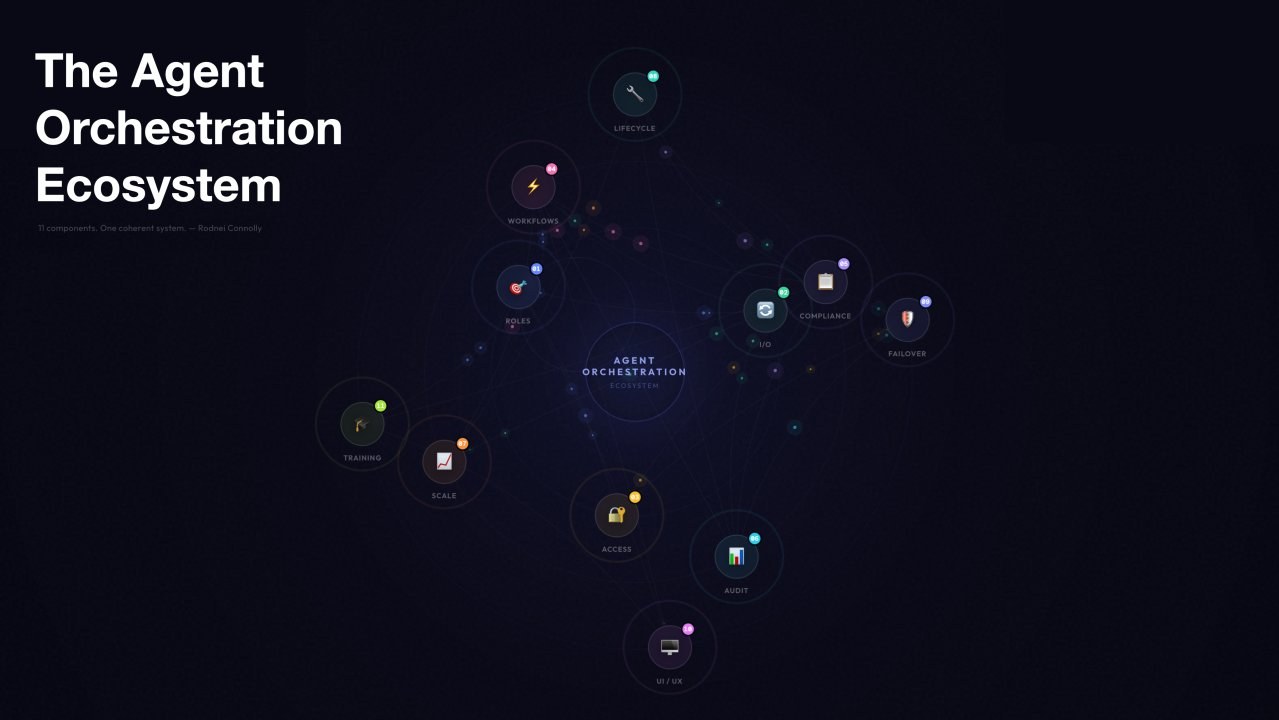
Through building, deploying, and scaling agent systems in production, I've identified eleven distinct components that together constitute a complete orchestration ecosystem. Each one is a workstream with its own ownership, deliverables, dependencies, and timeline. None of them are optional. And none of them work in isolation.
Foundation
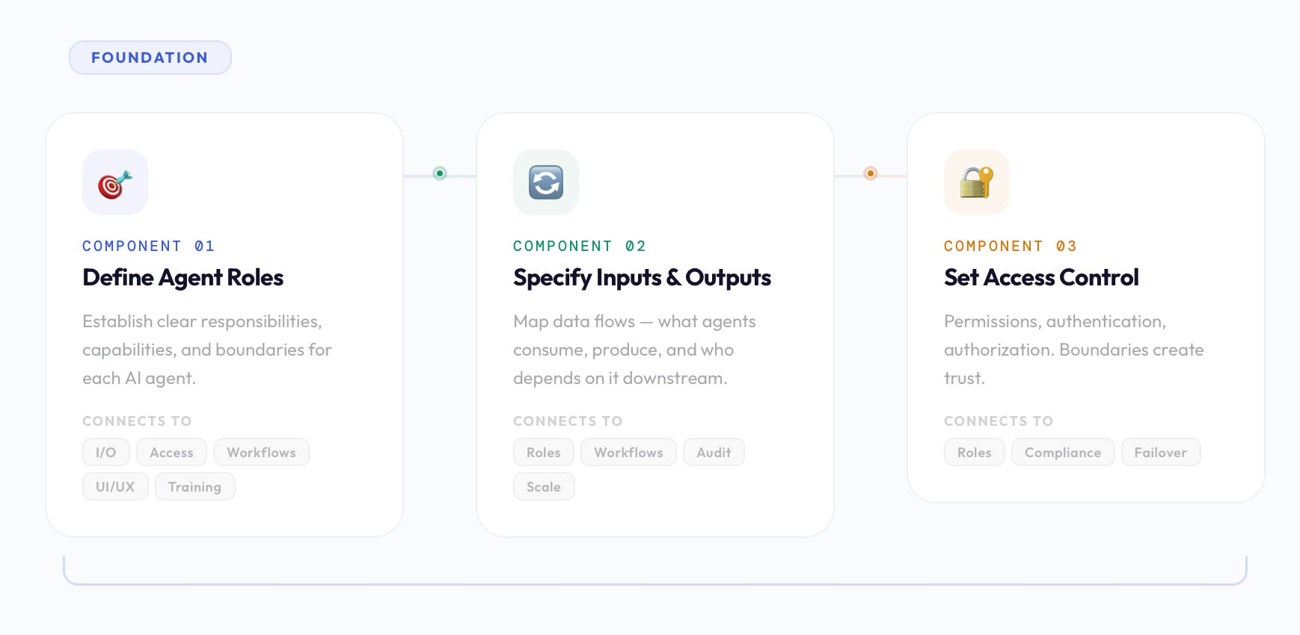
- Define agent roles. Establish clear responsibilities, capabilities, and boundaries. Every agent has a defined purpose — and defined limits.
- Specify inputs & outputs. Map what data agents consume, what they produce, in what format, and who downstream depends on it. This is the connective tissue of the ecosystem.
- Set access control. Permissions, authentication, authorization. Not every agent accesses every system. Boundaries create trust.
Operational
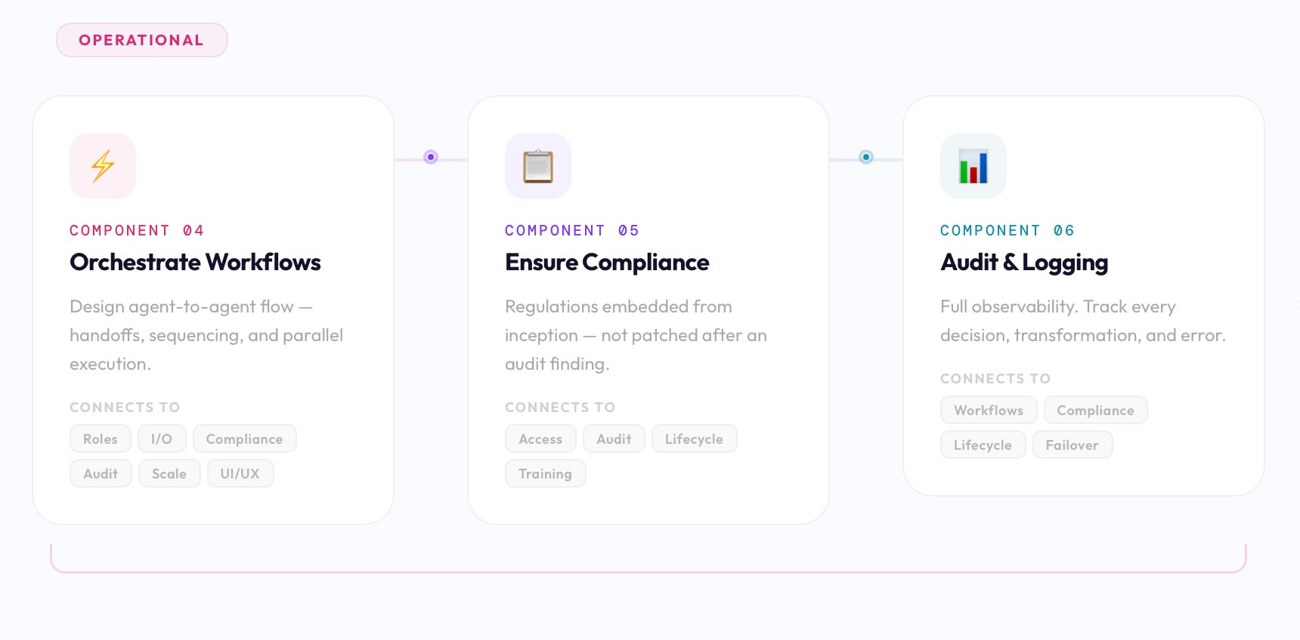
- Orchestrate workflows. Design the flow between agents — handoffs, sequencing, parallel execution, and multi-agent collaboration. The heartbeat of the ecosystem.
- Ensure compliance. Regulatory requirements, industry standards, and internal policies embedded into agent behavior from inception — not patched in after an audit finding.
- Audit & logging. Track every decision, transformation, and error. Full observability across the ecosystem. You can't orchestrate what you can't see.
Resilience
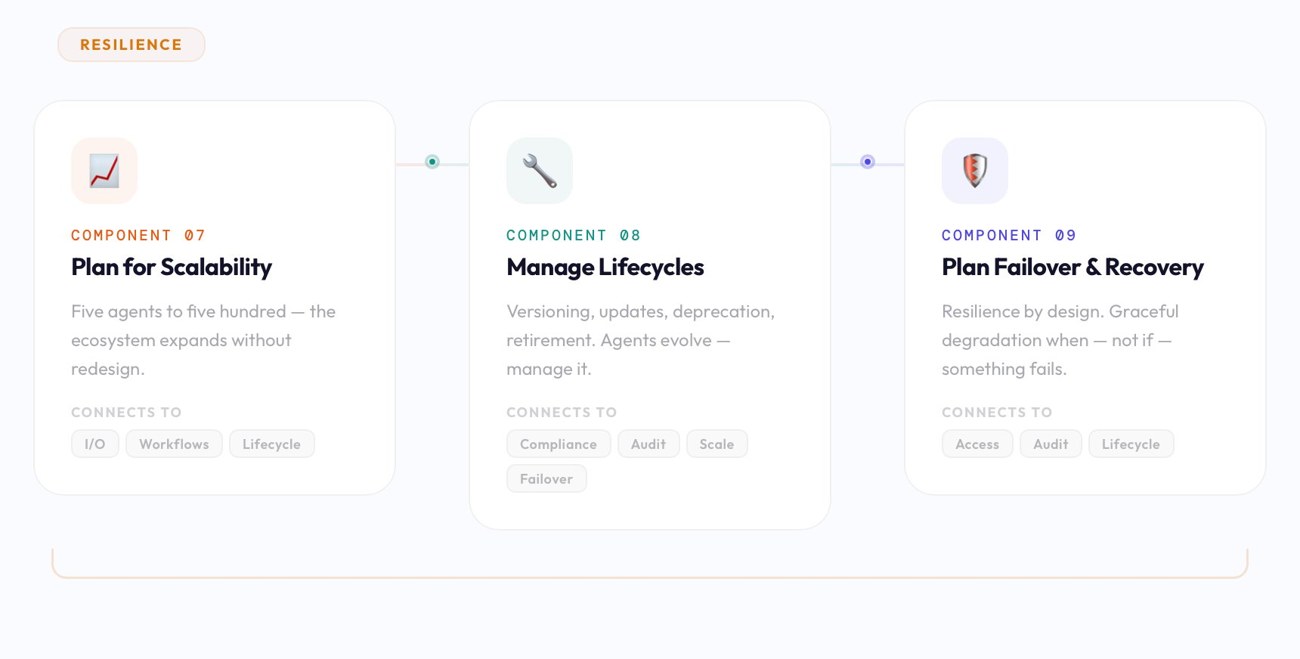
- Plan for scalability. Architecture that grows. Five agents to fifty to five hundred — the ecosystem expands without redesign.
- Manage lifecycles. Versioning, updates, deprecation, retirement. Agents are living systems that evolve. The ecosystem manages that evolution.
- Plan failover & recovery. Resilience by design. Fallback mechanisms, graceful degradation, and business continuity when — not if — something fails.
Enablement
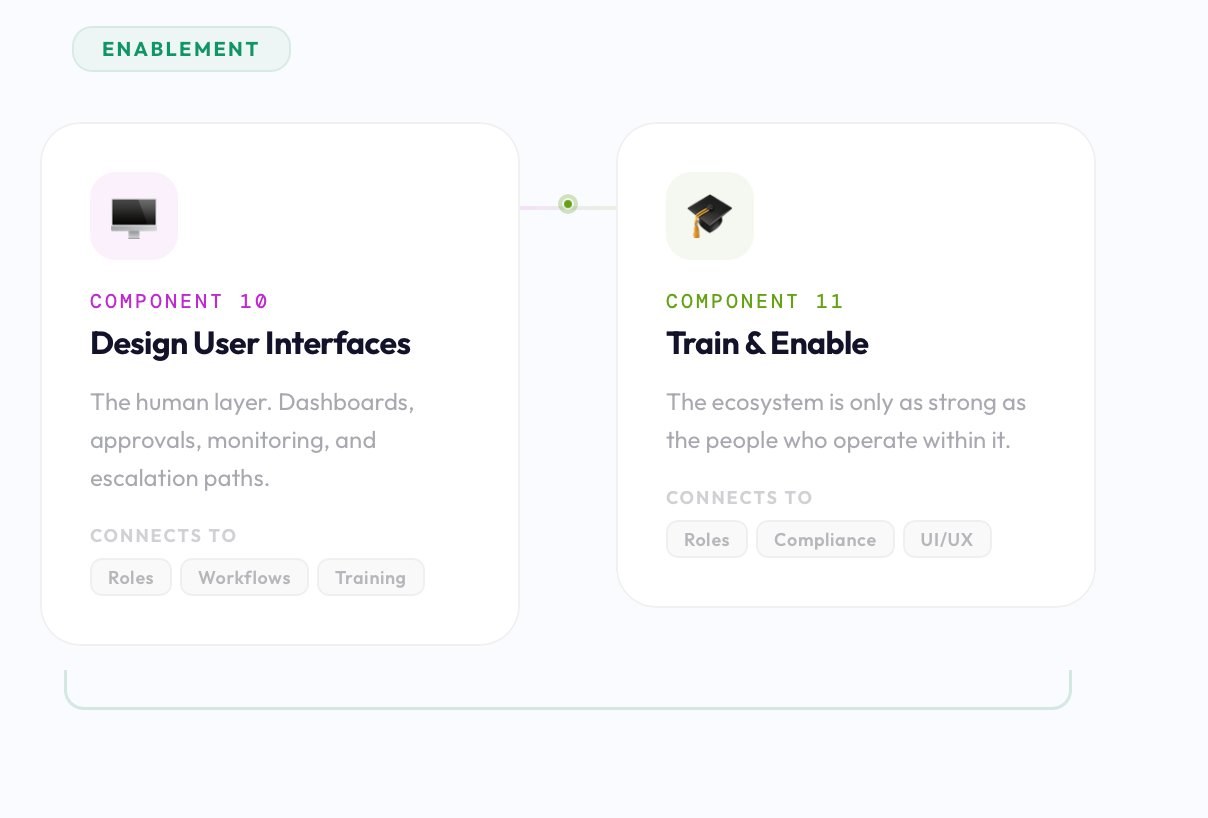
- Design user interfaces. Intuitive human-agent interaction. Dashboards, approval workflows, monitoring, escalation. The human layer of the ecosystem.
- Train & enable. Adoption programs, documentation, and support. An orchestration ecosystem is only as strong as the people who operate within it.
An Ecosystem, Not a Checklist
Here's where most frameworks fall apart: they present components as a linear sequence. Do step one, then step two, then step three. Enterprise orchestration doesn't work that way.
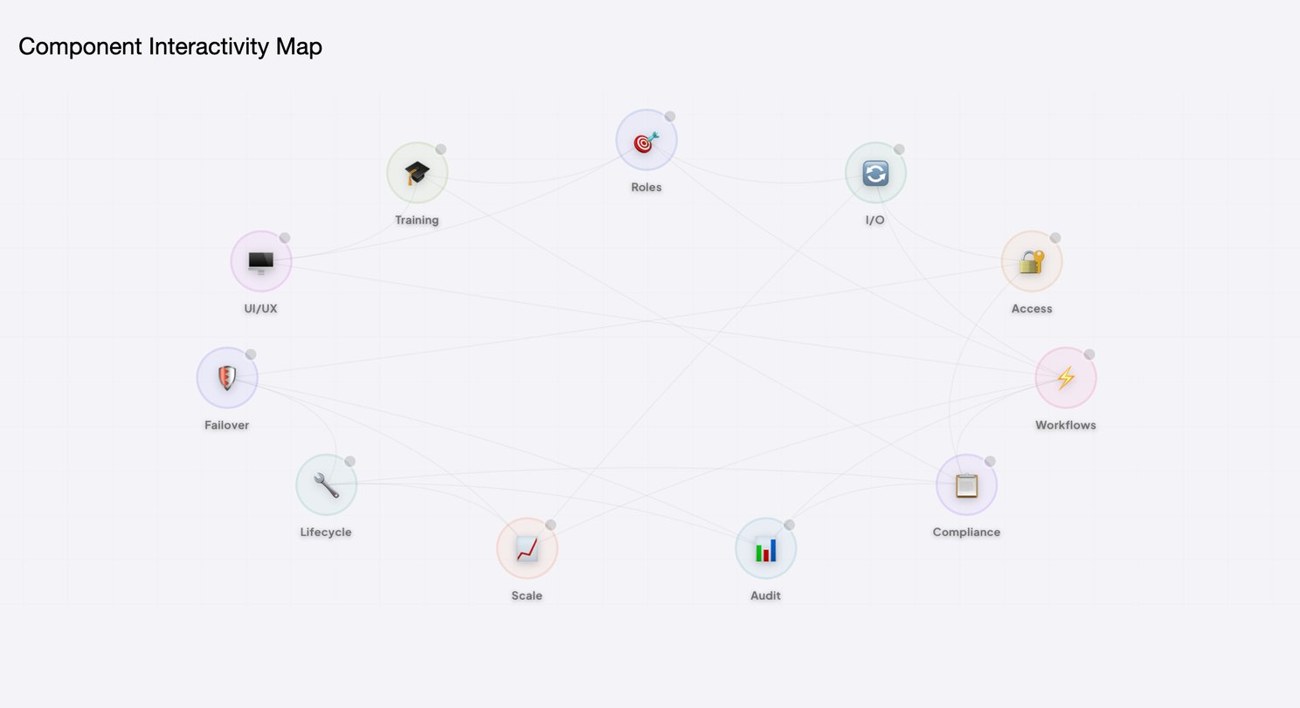
In practice, you're working across five or six components simultaneously. Onboarding a new agent touches role definition, access control, workflow orchestration, compliance, and training all at once. A model migration triggers lifecycle management, failover planning, audit logging, and interface updates in parallel. These components form an interconnected mesh — a living ecosystem where changes in one dimension ripple across others.
- You can't orchestrate workflows without defined roles.
- You can't ensure compliance without audit logging.
- You can't scale without lifecycle discipline.
- You can't train people without documented interfaces.
That interdependence is the point. It's what makes orchestration a system rather than a collection of practices. That's why I built this framework as an interactive map — not a waterfall. You need to see the dependencies, the overlaps, the parallel workstreams. Because that's how the work actually happens.
Closing the Cost Loop
Here's where the orchestration ecosystem connects directly to the cost reality. Every hidden cost leak maps to a gap in the ecosystem:
- Day-2 cost overruns? A lifecycle management gap. Organizations without versioning discipline and deprecation planning are perpetually reactive — and reactive is the most expensive way to operate.
- Unbudgeted model migrations? A failover and portability gap. When resilience is designed in, a provider change is a managed transition — not a crisis.
- Human-in-the-loop costs dominating the budget? An interface design gap compounded by a workflow orchestration gap. Better interfaces reduce review time; better orchestration reduces the volume of reviews required.
- Compliance scrambles after audit findings? Compliance embedded too late and insufficient observability. When both are native, audits become demonstrations of maturity — not fire drills.
- Scaling costs that spiral non-linearly? A scalability architecture gap. Without shared patterns, every new agent is a custom build, and technical debt compounds.
The orchestration ecosystem doesn't just organize your agents. It structurally eliminates the cost leaks that make AI investments underperform.
Five Things Production Taught Me
- Roles and access control are the foundation. I've seen teams jump straight to workflow orchestration without defining what each agent is authorized to do. That's wiring a building before drawing blueprints. Components 1 and 3 come first; everything else builds on them.
- Observability is non-negotiable — in every industry. Every organization eventually faces a "what happened?" moment. Without comprehensive logging from day one, reconstructing the chain of events is archaeology, not operations.
- Lifecycle management saves more money than any optimization. Model deprecations, prompt drift, and version conflicts are inevitable. Teams with lifecycle discipline absorb them smoothly; everyone else firefights — and firefighting is compound interest on technical debt.
- Failover is a design decision, not an incident response. If the first time you think about what happens when an agent fails is when it actually fails, you're already in crisis. Resilience gets designed in from inception — not bolted on after the first outage.
- Training is the bridge between building and adoption. I've deployed ecosystems that were architecturally sound and operationally irrelevant because nobody was equipped to work within them. It's the difference between "we built it" and "people actually use it."
Final Thoughts
The organizations that win with AI won't have better models — they'll have better systems.
If your agents are working but your outcomes aren't improving, the problem isn't intelligence. It's architecture. Until your agents operate as a cohesive system, AI at scale is just expensive experimentation.
I'm curious — how are you thinking about orchestration in your organization today? What's working, and where are you seeing gaps? If this is something you're exploring, I'd welcome the conversation.
All figures, percentages, and cost ranges referenced are illustrative and based on generalized enterprise scenarios. Actual costs and outcomes vary by organization, industry, agent complexity, provider pricing, and regulatory environment. Use these as directional benchmarks — not actuals — and calibrate to your own context.