
Future Innovation in the AI Era
Beyond implementation: navigating ethics, change management, and future innovation in the AI era.
In my previous article, we explored how generative AI is reshaping organizational culture, leadership approaches, and operational frameworks through dynamic Centers of Excellence. Now let's venture deeper into the strategic considerations that determine long-term success: ethical AI governance, overcoming organizational resistance, and leveraging AI as a catalyst for sustainable competitive advantage.
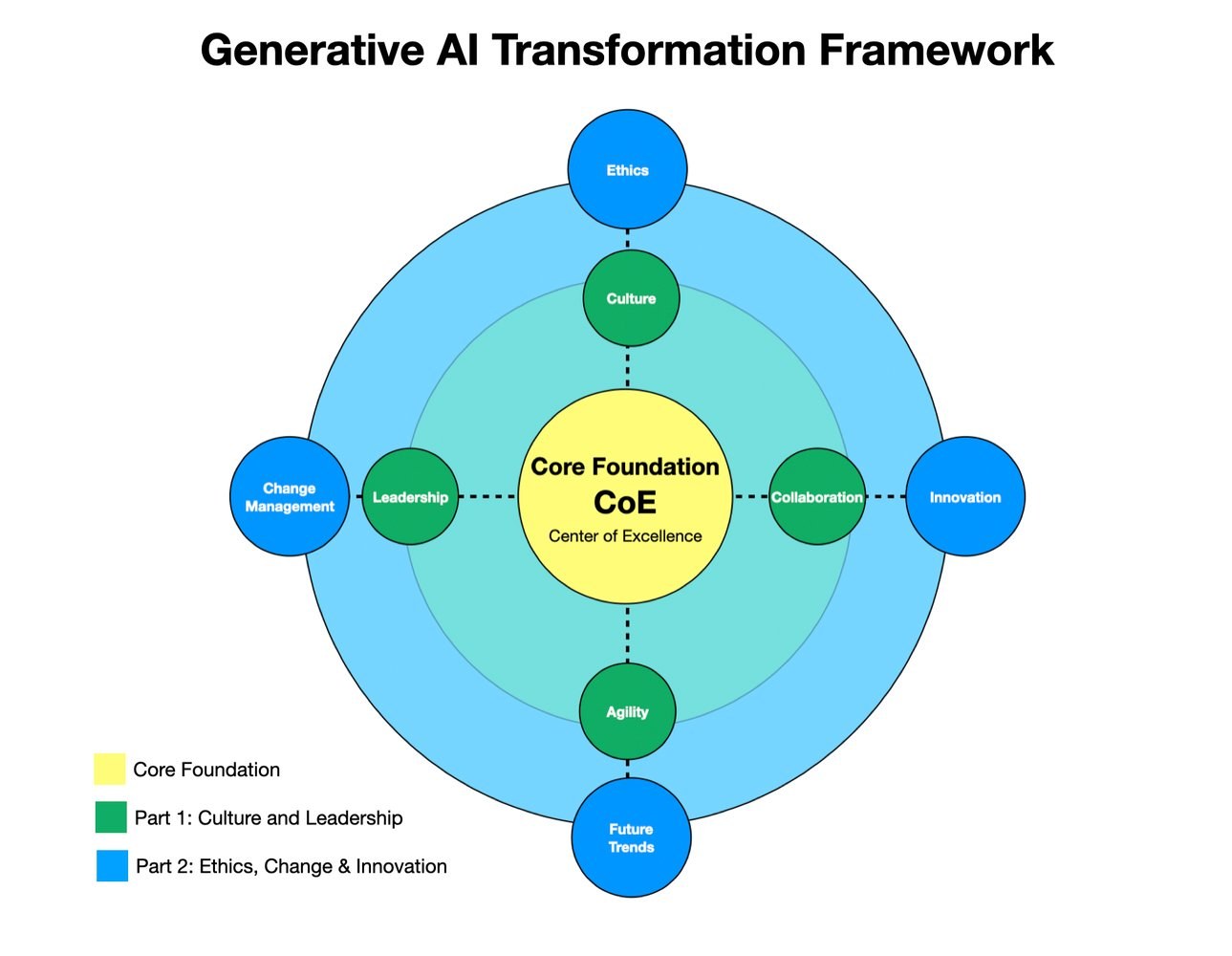
Ethical AI: Building the Foundation of Trust
As AI capabilities expand, so too must our commitment to ethical implementation. Trust — from employees, customers, and regulatory bodies — is the cornerstone of successful AI integration.
Creating Robust Accountability Systems
Organizations must establish clear accountability structures to ensure responsible AI usage:
- Clarify ownership. Designate specific roles for AI governance components, from data stewardship to model-performance monitoring. This clarity prevents oversight gaps and ensures timely intervention when issues arise.
- Implement regular auditing. Develop systematic review processes that examine AI systems for bias, security vulnerabilities, and alignment with organizational values — incorporating both internal expertise and external perspectives to maintain objectivity.
- Document decision pathways. Create transparent records of AI-driven decisions, capturing the underlying data, reasoning, and human oversight. This serves both as a trust-building mechanism and an invaluable learning resource.
Stakeholder-Centric Communication
Transparency must extend beyond internal processes to encompass all stakeholders affected by AI:
- Customer education. When AI influences customer experiences — through recommendation engines or service automation — provide clear, accessible explanations of how these systems work and the safeguards protecting privacy and fairness.
- Regulatory engagement. Proactively communicate with regulatory authorities about your governance framework. This forward-looking approach demonstrates good faith and positions you to adapt swiftly to evolving compliance requirements.
- Internal knowledge sharing. Equip your workforce with a fundamental understanding of your ethical AI principles, so employees become frontline guardians of responsible implementation and ethical considerations become second nature.
Transforming Resistance into Momentum
Even the most promising technological advances face headwinds from organizational inertia. Acknowledging this reality is the first step toward effective change management.
Building a Change-Ready Culture
- Empathetic leadership. AI adoption creates genuine concerns about skill relevance and job security. Create psychological safety through transparent communication, reskilling opportunities, and celebrating how AI augments — rather than replaces — human capabilities.
- Success storytelling. Identify and amplify early wins where AI has delivered tangible benefits. These narratives shift perceptions from theoretical potential to practical value.
- Measured implementation. Avoid overwhelming the organization with simultaneous, sweeping changes. Sequence initiatives to build confidence and competence progressively, letting teams internalize new workflows before tackling more complex transformations.
Harnessing AI for Strategic Differentiation
At its most powerful, generative AI transcends efficiency improvements to unlock unprecedented innovation potential and competitive advantage.
Catalyzing Cross-Functional Innovation
- Business-model exploration. Apply AI-driven insights to identify emerging market signals and unmet customer needs that could inspire entirely new value propositions or revenue streams.
- Research acceleration. Leverage AI's pattern recognition to analyze complex datasets that reveal non-obvious correlations and accelerate your innovation pipeline — in product development, service design, or operational optimization.
- Experience personalization. Build AI systems that create deeply individualized customer journeys from behavioral analysis, preference mapping, and contextual understanding — elevating engagement from transactions to relationships.
Maintaining Competitive Edge
In today's rapidly evolving landscape, sustainable advantage requires continuous evolution:
- Forward-looking technology investments. Allocate resources to current AI capabilities and to emerging methodologies that show promise for future differentiation.
- Ecosystem development. Forge partnerships with academic institutions, startups, and industry consortia that provide access to cutting-edge research and specialized expertise beyond your boundaries.
- Scale planning. Design implementations with enterprise-wide scalability in mind, so successful pilots can rapidly expand across business units and geographies.
Preparing for Tomorrow's AI Landscape
As generative AI matures, several trends warrant strategic attention:
- Ultra-personalization. AI will enable unprecedented customization of offerings, experiences, and workplaces tailored to individual needs at scale.
- Augmented creativity. AI will increasingly serve as a collaborative partner in creative work — from content and design ideation to strategic scenario planning.
- AI-IoT convergence. The fusion of AI with the Internet of Things will transform physical operations through predictive maintenance, autonomous systems, and real-time optimization.
- Evolving governance. Expect continued development of regulatory frameworks that shape implementation and compliance, necessitating agile governance structures.
Embracing the Continuous Journey
Integrating generative AI into your organization is not a destination but an ongoing evolution that intertwines technological capability with cultural transformation. By fostering adaptive mindsets, distributed decision-making, and unwavering ethical commitments, you create an environment where AI enhances human potential and drives meaningful innovation.
Today's implementation challenges represent tomorrow's competitive advantages.
Each cross-functional collaboration, each data-informed decision, and each ethical framework strengthens your organization's capacity to harness AI as a strategic accelerant rather than merely a tactical tool.
I welcome continued dialogue on these possibilities. Whether you're guiding executive strategy, implementing mid-level changes, or exploring practical applications, your perspective enriches our collective understanding of how to navigate this technological inflection point responsibly and effectively.