
AI Is Making Performance Visible
Why the tools are becoming equal and the outcomes are not.
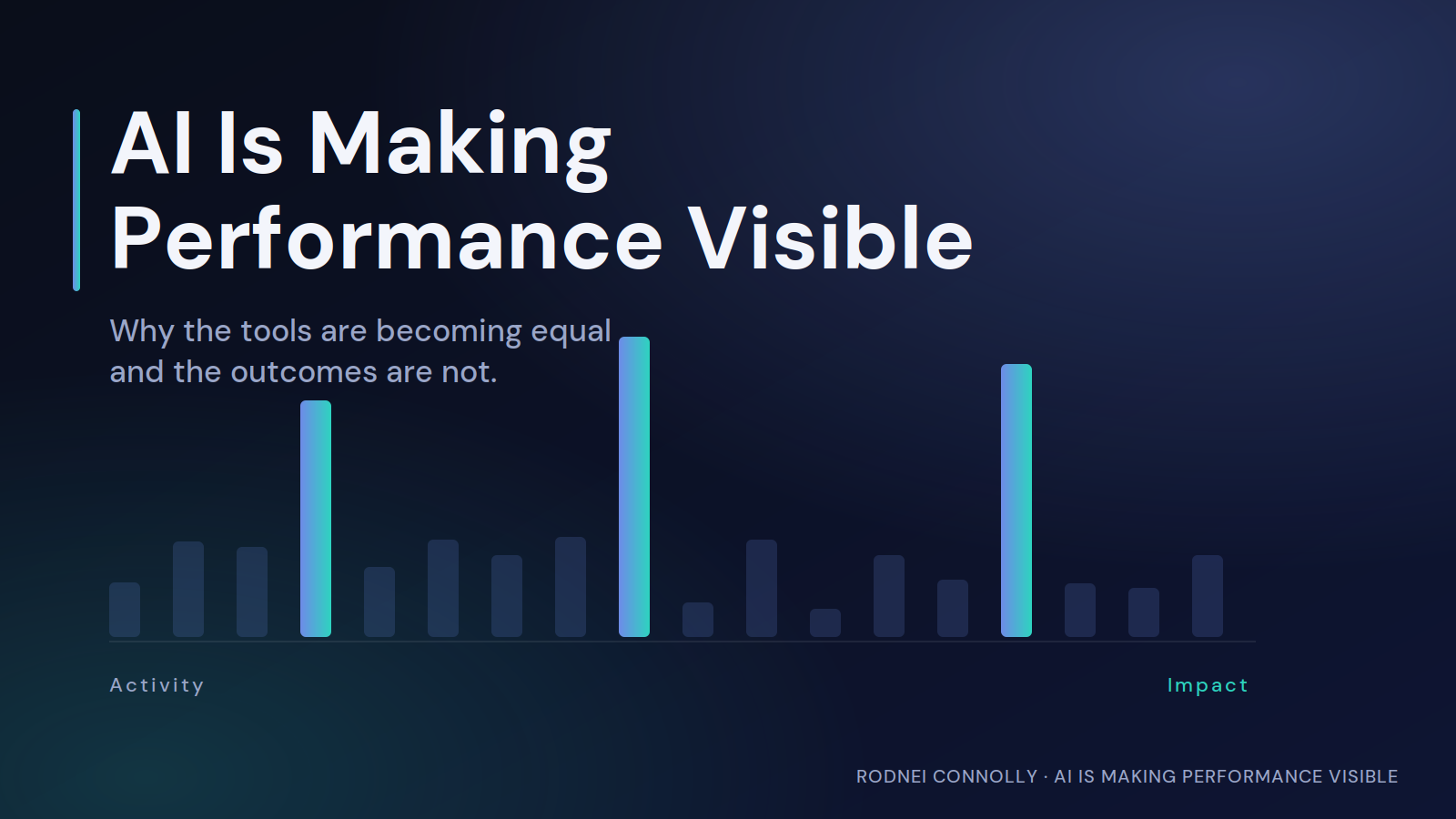
The same thing keeps happening, and I have now watched it enough times to trust it.
Several people get the same AI tools, the same information and the same problem. Different levels of experience: some early in their careers, some decades in. A week or so goes by.
Some come back with their existing work done faster. A cleaner deck, a quicker analysis, the same deliverable delivered sooner. Reasonable. Useful.
Others come back with something nobody asked for. They questioned whether the problem was the right problem. They tried three alternatives. They connected two things that don't usually sit together. They built a rough version and ran it. They came back with an outcome instead of a status.
The tool was becoming more equal. The outcomes were not.
That is the whole thesis. It took me a while to see what I was actually looking at.
The proximity premium
For most of my career, performance inside large organizations has been read partly through presence. Who was in the meeting. Who presented. Who was associated with the initiative when it went well. Who managed upward with skill.
None of those are bad skills. Communication, stakeholder management and influence are real leadership capabilities. The problem is that in a slow organization they earn a premium that has nothing to do with moving the work.
I call it the proximity premium: the reward for being near the work rather than for changing it.
I am not standing outside this. My own lens on productivity was built in that world, and it measured a good week partly by what I had produced and where I had been seen. It took AI changing how I worked to notice how much of that was activity.
Why the fog is lifting now
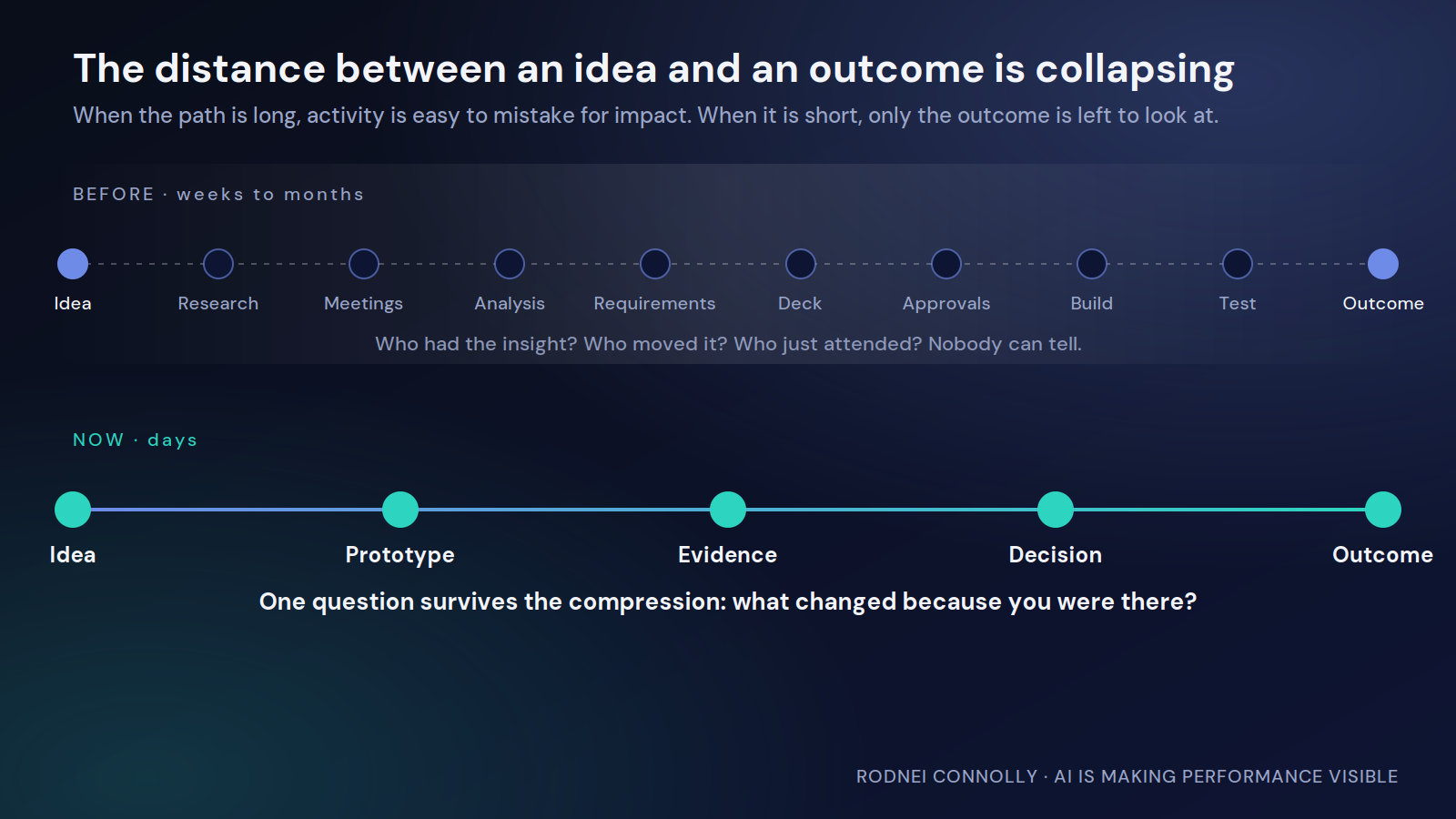
Knowledge work used to have a long path. Idea, then research, then meetings, analysis, requirements, a deck, approvals, build, test, revisions. Weeks or months later something tangible appeared.
That distance created fog. Along a path that long it is difficult to tell who generated the insight, who removed the ambiguity, who executed, and who simply participated. The proximity premium lives in that fog.
AI is compressing the path. A capable person can now go from an ambiguous problem to research, hypotheses, a prototype, a test and something close to production in days. When the path is that short there is less room to stand near the work. There is mostly the outcome, and the question of who produced it.
Access is not capability
The common assumption is that giving everyone powerful models levels the field. I don't think it does. If anything, I am seeing the reverse.
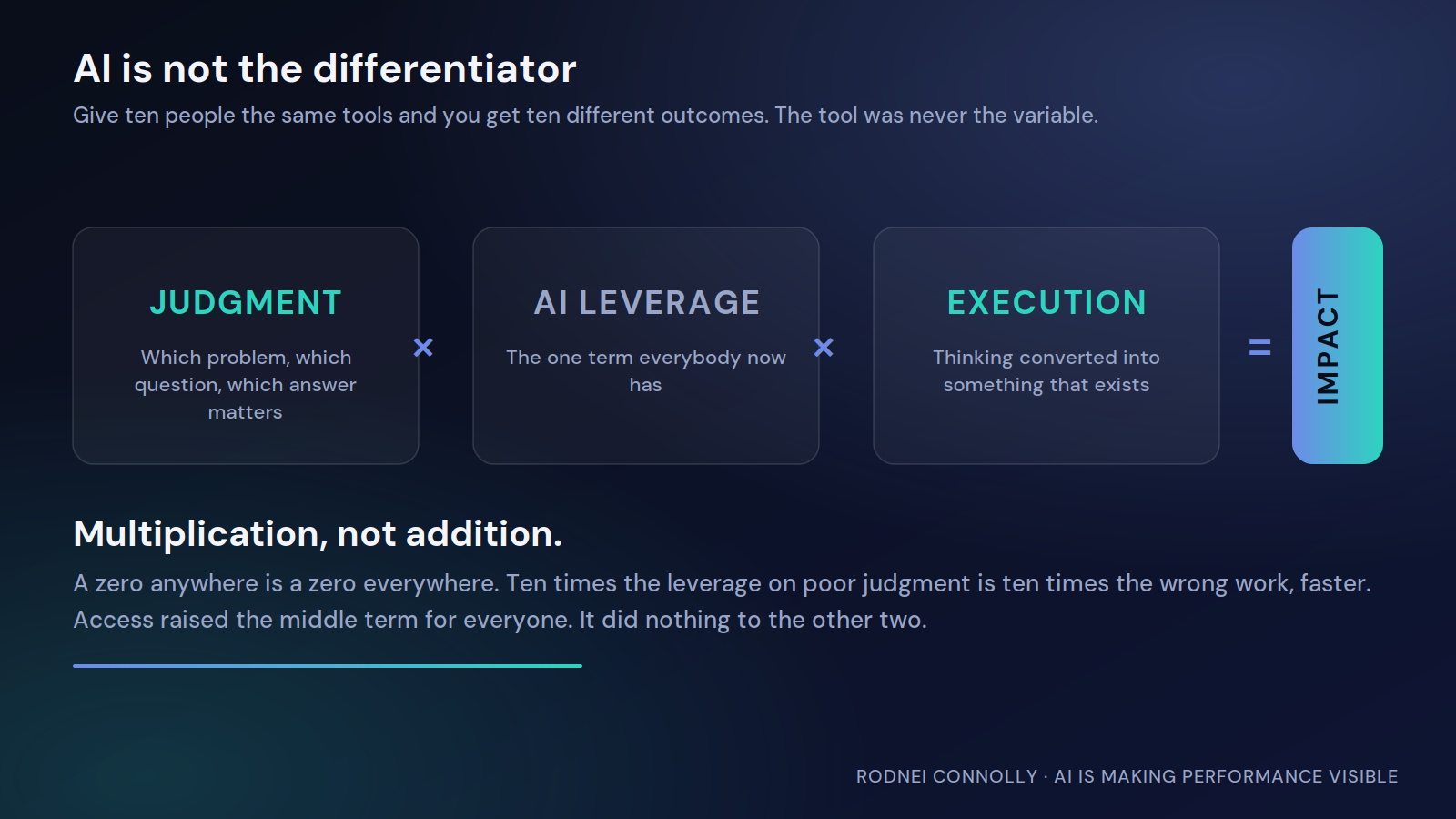
Access to information was never the differentiator. The differentiator is the human capability wrapped around the tool: judgment about which problem matters, curiosity, the ability to frame a question, the willingness to try something and the discipline to finish it. AI amplifies those. It does not install them.
That is why I think of it as multiplication rather than addition.
JUDGMENT × AI LEVERAGE × EXECUTION = IMPACT
Everyone's middle term just went up. A zero in either of the other two is still a zero. Ten times the leverage applied to poor judgment is ten times the wrong work, delivered faster.
The Performance Transparency Effect
I want to be precise about what is happening, because the lazy version is dangerous.
As AI collapses the time between thinking and output, contribution becomes easier to observe through outcomes. I call this the Performance Transparency Effect.
Not surveillance. Not keystrokes, hours online, or how fast someone answers a chat. Not an algorithmic employee score, which I would argue against in any organization I am part of. Something much plainer: what changed because you were there?
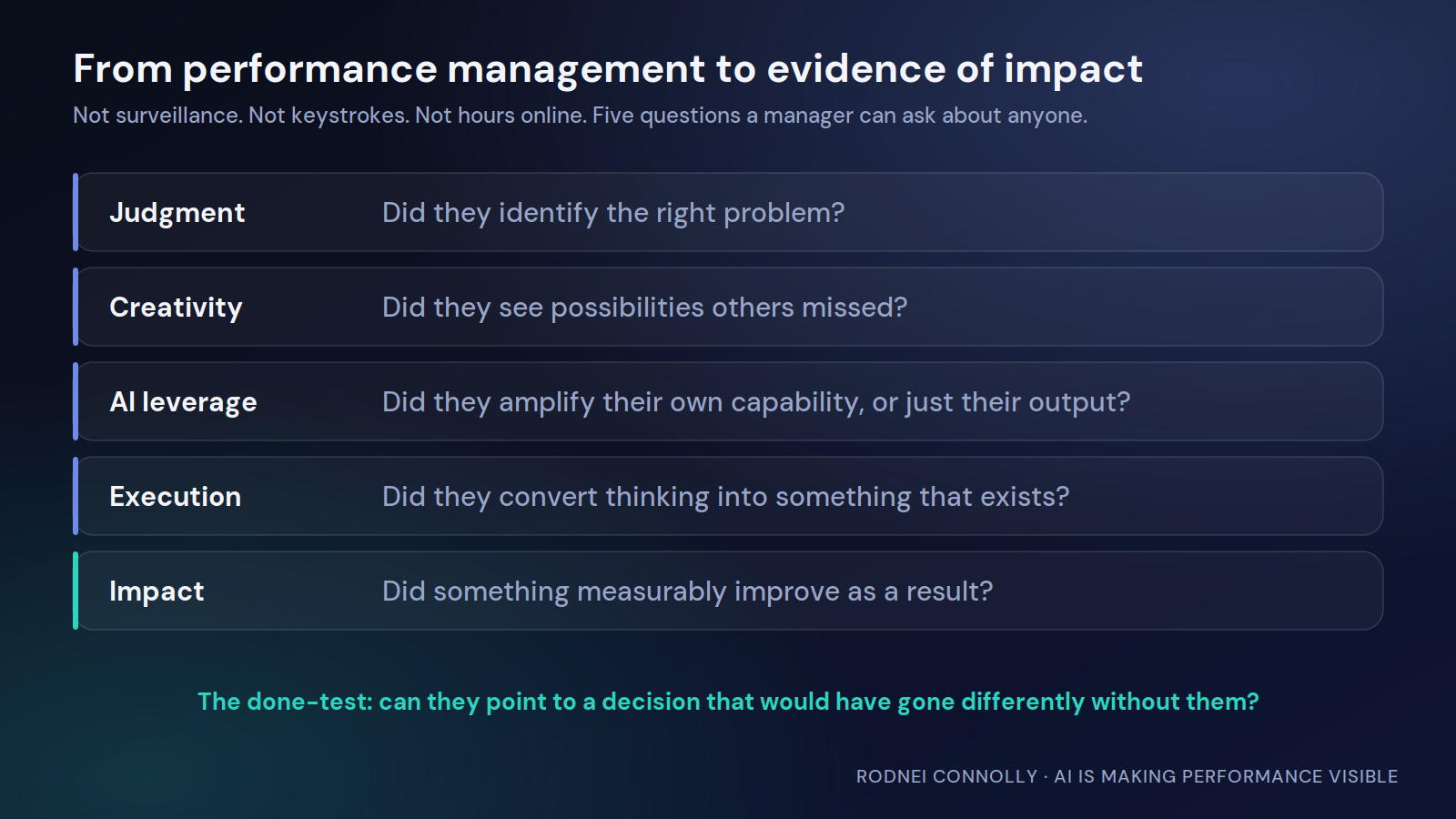
The done-test I now use for any contribution, including my own, is a single question. Can the person point to a decision that would have gone differently without them? If yes, that is impact, whatever the artifact count. If no, it was activity, however polished.
That question has always been the right one. AI is making it harder to avoid.
The questions I now ask
These are the questions I would put to anyone, at any level, about any piece of work. Each one exposes something specific.
“What problem did you decide was the real one?” — exposes judgment, and whether they accepted the framing they were handed.
“What did you build to find out?” — exposes whether they prototype or debate.
“What did you learn that you didn't expect?” — exposes whether AI was used to interrogate their thinking or to confirm it.
“What decision did that change?” — exposes execution: the point where thinking became something that exists.
“What would have happened if you hadn't been there?” — exposes impact, and whether they can tell their contribution from the team's.
Five dimensions sit underneath those questions: judgment, creativity, AI leverage, execution and impact. Notice that “how much AI did you use” is not one of them.
What I got wrong
I have adopted every new technology I could get my hands on for twenty-five years, and my habit has been to turn it into something practical quickly. So I did not come into AI thinking it would suddenly make me more capable.
What changed was my understanding of how it amplifies what is already there. My creativity, critical thinking and bias for execution started operating at a speed they had never operated at. Ideas that took weeks to explore could be challenged, prototyped and tested in days. That changed my lens on my own productivity first.
Then it changed how I looked at other people. The default framing of AI at work is surveillance, or anxiety about whether anyone's work still matters. The biggest shift in my thinking was rejecting that framing. What I saw instead was that AI made certain human capabilities visible across every level of experience: curiosity, judgment, initiative, what someone does with ambiguity, whether they can close.
The technology does not erase differences in experience. It gives people leverage, and leverage shows you how they think.
I started calling it a mirror. It reflects the quality of the questions we ask, whether we can tell information from insight, and whether we can execute. For me personally the mirror has been clarifying rather than threatening. It has made me more confident about where to spend my time: not on producing more, but on choosing better.
My stake in this
I should say plainly that I have an interest here. I run an AI and forward-deployed engineering function. Measuring people by what they changed rather than by what they attended rewards exactly the kind of builder I hire and exactly the kind of work my teams do. Discount accordingly, then look at your own organization and decide whether the argument holds anyway.
“Won't the same people just game the new evidence?”
This is the objection I find hardest, and it is at least half right.
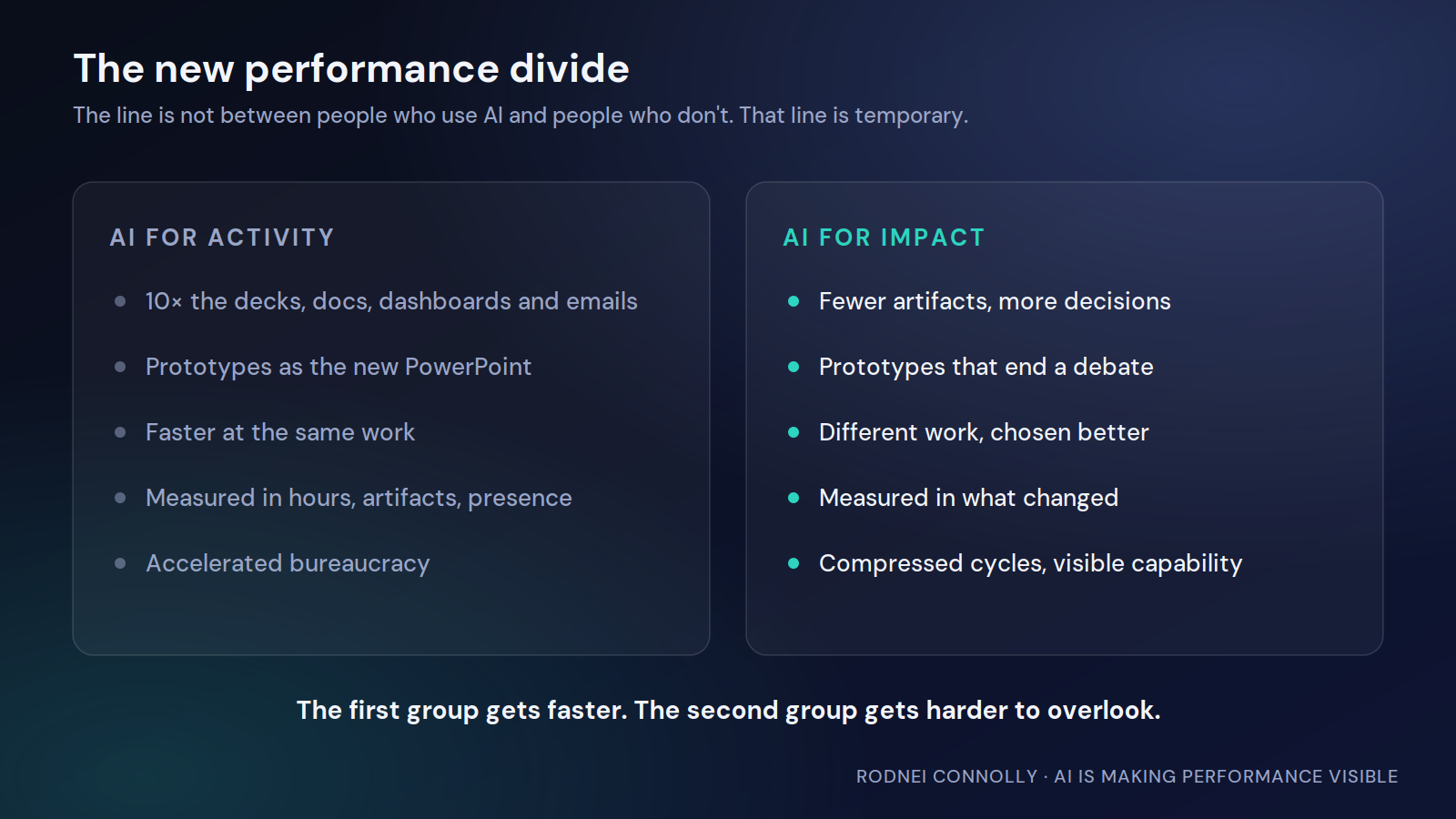
The people who were skilled at the proximity premium are skilled people. When evidence becomes cheap, some of them will become skilled at producing it. Prototypes become the new PowerPoint. Ten times the documents, dashboards and demos, and no more decisions than before. That is not transformation. It is AI-accelerated bureaucracy, and I expect a lot of it.
Two things still change.
The first is about the evidence itself.
A prototype can be run. A deck can only be presented. Evidence that can be tested by the person receiving it is harder to inflate than evidence that can only be described. And the done-test above is not something you can attend your way into. A decision either would have gone differently or it would not, and the people who were in the room usually know which.
The second is on leaders, and it is the bigger one. Compression only makes performance visible to people who look at outcomes. If leadership keeps counting hours, meetings and artifacts, the compression will penalize the people using AI best, because they will look less busy. The measurement has to move upstream, and that is a leadership decision, not a technology one.
The people who become visible for the first time
The part I find most hopeful is who shows up in the mirror.
The quiet engineer. The person who challenges assumptions and has no patience for corporate theater. The employee who thinks differently and never had the resources to show it. Instead of needing a team of ten to demonstrate an idea, one of them can build a working version. Instead of asking permission to investigate for three weeks, they can bring evidence on Thursday.
Evidence becomes a form of influence. The proximity premium starts to lose to it. That is healthy, and it is overdue.
The question I'd ask first
Before “who is using AI?”, the question I would put to any leadership team is: what is AI letting us see about our people that we could not see before?
The scarce thing was never access to the tool. Everyone has it now. The scarce thing is judgment about where to point it, and the willingness to turn what comes back into something real.
Access to AI made everyone faster.
Judgment decides what is worth doing with it.
Execution is what finally makes that judgment visible.
So, in your organization: when the fog lifts, who becomes visible?
About the author
Rodnei Connolly is a product, AI and enterprise transformation leader focused on turning emerging technology into measurable business outcomes at scale.
Authorship note: This piece reflects Rodnei Connolly's personal perspective based on experience leading AI-enabled transformation and enterprise technology initiatives. AI tools were used as part of the research, ideation, and editorial process; the thesis, perspectives, judgment, and conclusions are his own.